Loop closed: tomorrow’s power tools made with yesterday’s plastic
Bosch Power Tools stands for innovation, quality and reliability. So there was no room for compromise when creating the Closed Loop Edition of the UniversalImpact 800 drill.

“Using plastic recyclate for series production presents a number of challenges — particularly in terms of availability, processability and quality. But together with MKV and HolyPoly, we proved that a circular economy is possible for power tools too.”

Anne Purper,
Bosch Power Tools
78 % recycled technical plastic from old power tools is used in the product housing of the UniversalImpact 800 Closed-Loop Edition
(In all externally visible components of the main product without cables and accessories)
The Closed Loop Edition of the Bosch UniversalImpact 800 drill proves to the entire sector that a circular economy for power tools is possible!
HolyPoly collaborated with the compounding company MKV and Bosch Power Tools to provide an example of a closed-loop, end-to-end process for an impact drill – from take-back for end-of-life power tools and plastic recycling to using the recyclate to create a special edition.
This success was made possible by an extensive feasibility study that analysed thousands of end-of-life power tools. The data collected was used to create a unique database and this proved to be a game-changer in developing virgin-quality recyclate.
The result was a closed-loop power tool that embodies an uncompromising approach to recycling.

Generational technology
Robert Bosch GmbH is a global player that encompasses a wide range of fields. The group’s expertise is highly regarded by both consumers and numerous industrial sectors. Bosch’s most popular consumer products include household appliances and power tools.
The group’s motto “Technology for Life” also applies to the Bosch Power Tools division. Quality, durability, performance and Bosch’s commitment to environmental, economic and social sustainability for all its business activities are all key reasons to choose Bosch products.
“Thanks to the project with HolyPoly, we now have technical evidence that we can keep our plastics in a closed-loop system. The project addresses several key areas of our sustainability strategy: responsible use of materials, circularity and CO₂ reduction.”
The challenge: recycling without special treatment
In Germany, a power tool’s life cycle usually ends at the recycling centre. However, as the entire recycling chain is primarily geared towards metal, most other raw materials, including many tonnes of high-quality plastics, are incinerated. This is where our project with Bosch Power Tools comes in: the aim was to close the loop by producing a special edition of an impact drill with a housing made predominantly from recycled plastic sourced from end-of-life products. Because durable plastic deserves a second life!
“As materials account for a large proportion of our carbon footprint, it makes sense for us to focus on recycled plastics. This aim of this pilot project is to determine the technical and financial resources required to provide the necessary quantities and qualities of material.”

Thomas Hampel,
Bosch Power ToolsBut Bosch Power Tools faces a major challenge: power tools require materials that can withstand both fluctuating thermal stresses and the impact loads encountered in testing. One of the engineering plastics frequently used for this purpose is PA6-GF30. However, it is rarely available on the secondary raw materials market in the required quality and colouring.
Bosch Power Tools aims to overcome this shortage by establishing its own material loop for plastics from power tools and, in doing so, set new standards for the sector.

The materials used are the single greatest contributing factor to the carbon footprint of power tools. Using recycled plastics is crucial to reducing these emissions and achieving sustainability targets.
That’s where HolyPoly comes in ...
To realise this idea with Bosch Power Tools, HolyPoly has joined forces with the plastics recycling company MKV GmbH. Bosch was impressed by the results of the initial assessment of potential and decided to continue with a feasibility study. This came to a resoundingly positive conclusion and marked the start of production for the UniversalImpact 800 Closed Loop Edition.
“The challenge was to produce a recycled plastic made from old tools for a special edition in a quality suitable for series production. This was completely uncharted territory — there were no established standards or documented practical experience to fall back on. Still, we managed it thanks to the wide-ranging expertise and awe-inspiring determination of everyone involved.”

Pascal Haaf,
HolyPolyThe ultimate challenge was to demonstrate the practical benefits of the closed-loop system by directly comparing the special edition of the UniversalImpact 800 drill with the standard edition (made from virgin materials). The look, feel and quality had to be identical and the product had to prove its suitability for series production on Bosch’s standard production lines.
In short, it could not be a proof-of-concept subject that was treated as a special case. It needed to be a standard production run under normal industrial conditions and had to meet the requirements of both end users and the production facility.
Look

Feel

Quality

The process: success means closing the loop
The task of creating a closed-loop system for power tools was a real challenge even for the specialists at HolyPoly. At every stage of the process — from strategic planning and material sorting through to series production approval and marketing by Bosch Power Tools — the HolyPoly team drew on extensive specialist knowledge, a wide range of skills and innovative recycling approaches.
Among the key milestones were the development of a traceability and data solution, a database-supported disassembly workflow, friction washing, colour-based elastomer separation and on-site support during the creation of the material and housing.
“Despite a few rollercoaster moments during the project, the team always managed to find a solution thanks to their never-say-die attitude. We see HolyPoly’s real strength in its combination of a proactive, pioneering approach, genuine ownership of the issue, in-depth plastics expertise and a strong network. This played a key role our rapid achievement of results together.”
HolyPoly’s extensive network and MKV GmbH in particular proved indispensable to the Bosch team throughout this process. Partners included waste management companies permitted to process waste under German law, testing laboratories and injection moulders. Their expertise and capabilities in compounding and testing were just as crucial as their involvement in the potential assessment and feasibility study. Although HolyPoly was at the reins, this unprecedented achievement would not have been possible without close teamwork and Bosch’s trust.
“The two key questions we wanted to clarify in the feasibility study were: Is it possible to recover materials from old power tools? And if so, can we reuse it afterwards? The answer to both questions was a resounding ‘yes’.”
Feasibility study: A data-driven approach to achieving virgin-grade recyclate
What is actually possible? Behind this seemingly simple question lie numerous complex technical, economic and regulatory factors that determine whether a concept for producing a power tool from recycled engineering plastics can be implemented. To find the answer, a sample of several thousand end-of-life power tools of various types and from different years of manufacture was collected from primary treatment facilities for recycling and recorded in a unique database.
These were distilled into 13 scientific hypotheses on technical feasibility and economic viability to form the feasibility study’s roadmap. Four examples:
Feasibility
There is a sufficient supply of readily available engineering plastics.
Feasibility
There are plenty of end-of-life power tools available.
Viability
We can use visual characteristics to identify and sort old power tools that contain undesirable substances.
Viability
The identification of materials can be implemented cost-effectively.
During the recycling process, the plastics were divided into four different batches to test their processability and compliance with requirements. To ensure the highest quality, HolyPoly collaborated with eight partner companies to utilise state-of-the-art technologies at every stage of the process — from shredding and material separation to extrusion. Some of these technologies had not previously been used in plastics recycling.
The result won over even the most sceptical of experts. The recycled glass-fibre-reinforced plastic met the same high quality standards as virgin material. This meant it was ready for processing on Bosch’s existing production lines without any modifications to create housing components.
“The recyclate that we produced is of the same quality as the virgin material used by Bosch Power Tools and can be used in the same high-performance products.”

Kai Zies,
MKV GMBH

A specialised IT and analytics infrastructure was set up to create the unique tool database and more than half a million data points were recorded across three areas: product analysis, processing trials and material testing. Each of the power tools was completely dismantled and examined according to 35 criteria, including tool type, brand, dismantling time, X-ray fluorescence results, housing material and weight. Data was used to verify that only technically suitable, legally approved plastics (including any additives) reached the subsequent processing stages. This provided a valuable basis for assessing economic viability and identifying unsuitable materials at an early stage.
“We got so much information from the data and derived even more from it. The database was the key to our success and paved the way for the Closed Loop Special Edition.”


The tests compared manual and automated sorting according to the typical colours for Bosch Power Tools: green for DIY and blue for trade professionals. This was followed by extensive processing trials for various recycling technologies both in laboratories and on an industrial scale. This resulted in four test batches, which were tested to assess their mechanical, rheological and colour characteristics, as well as the presence of any critical substances to ensure the highest standards of material and product safety.
“To be honest, my expectations of the recycled material weren’t particularly high: I had anticipated a decent base mixture that we could work with after it had been thoroughly processed. In fact, we were able to immediately create products from the material without using any additives or extra glass fibres.”

From study to reality: the impact drill as a proof of concept
“When a proof of concept turns directly into a special edition, it’s a great opportunity to simultaneously assess technical feasibility, customer acceptance and market feedback.”
The feasibility study provided clear evidence that end-of-life power tools can be transformed into housing materials that meet Bosch’s high quality standards. But the decisive proof under real production conditions was still to come: Bosch Power Tools decided to demonstrate the first closed-loop, tool-to-tool material cycle with the UniversalImpact 800 Closed-Loop Edition. This drill can be found in many households and its housing contains a high proportion of PA6.
This flagship project aimed to demonstrate that the use of recycled material is feasible for series production and to provide insights into market viability and customer feedback.
In order to obtain sufficient material for the special edition, several thousand assorted old tools were collected and pre-sorted. These large quantities were necessary because the highest quality standards required an extremely detailed selection process. In the end, the only end-of-life power tools left were those that met all three selection criteria: green housing, glass-fibre-reinforced PA6 material and the absence of undesirable additives.

Exploration: The search for reliable sources of post-consumer plastic was passed on to primary treatment facilities for recycling and specialist recycling companies.

Sourcing: The collection of tens of thousands of end-of-life power tools took place via HolyPoly’s partner network.

Sorting: Not every green plastic housing meets Bosch’s standards: the material is only used in the next stage of the process if the blend is correct and contains no undesirable substances.
Once the tool had been dismantled and the remaining components recycled, the valuable PA6-GF material was recovered. The plastic was then shredded, sorted, cleaned and ground ready for compounding into the final material.

Analysis: HolyPoly’s unique database ensures that no end-of-life material poses a risk, as it provides information on the material blend and any undesirable additives in specific tool categories or from specific years of manufacture.

Disassembly: The plastic housing is separated from the motor and other components. External partners recycle the metal fractions and any reusable plastic parts are prepared for further processing.

Shredding: The mechanical recycling phase can now be integrated into industrial operations and begins in the shredder, where flakes are produced. After shredding, this primary feedstock that is then cleaned of any metal residues.

Processing: The final mechanical colour sortation is followed by thorough, multi-stage cleaning and drying until the material is ready for the mill, where it is ground into uniform granules with a carefully defined particle size.

Compounding: In this stage of the process at HolyPoly’s partner MKV, the various batches of granulate are mixed together to produce a homogeneous recyclate. This is then compounded (i.e. melted down) and prepared for Bosch’s production facility.
In the production halls of Bosch Power Tools and its partners, housing components for the Special Edition of the UniversalImpact 800 drills were manufactured from the recycled material.
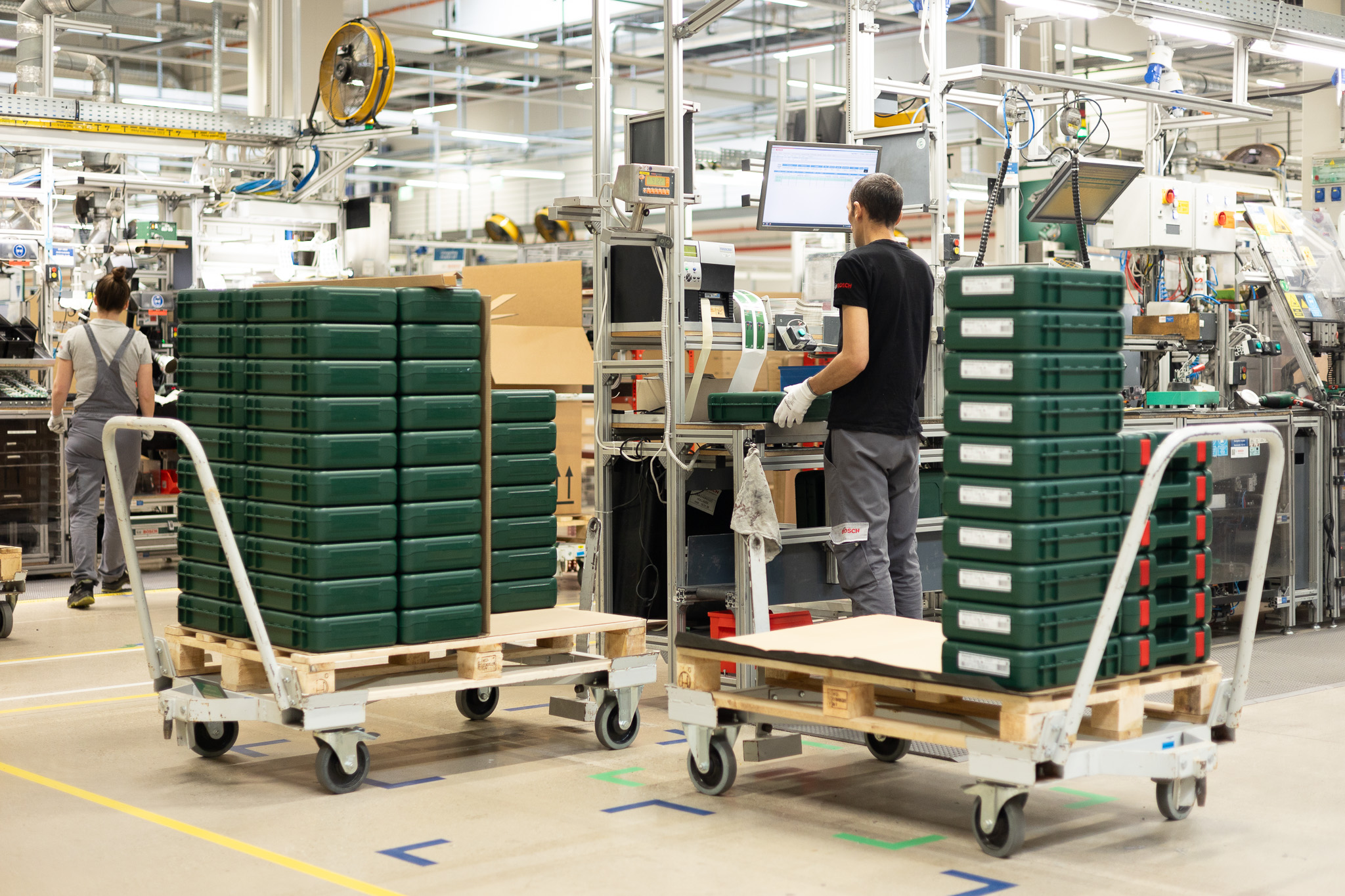
Commissioning
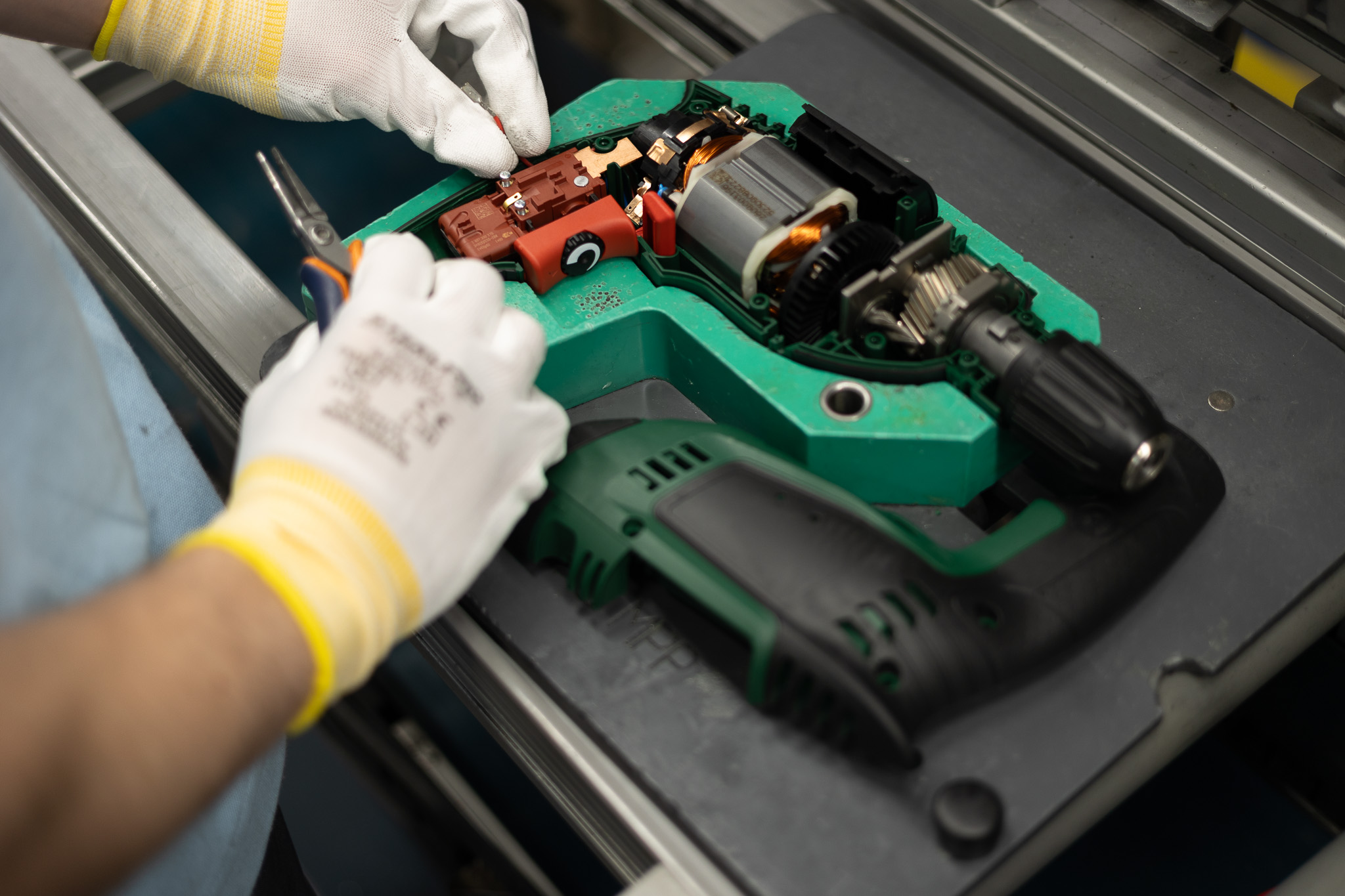
Assembly
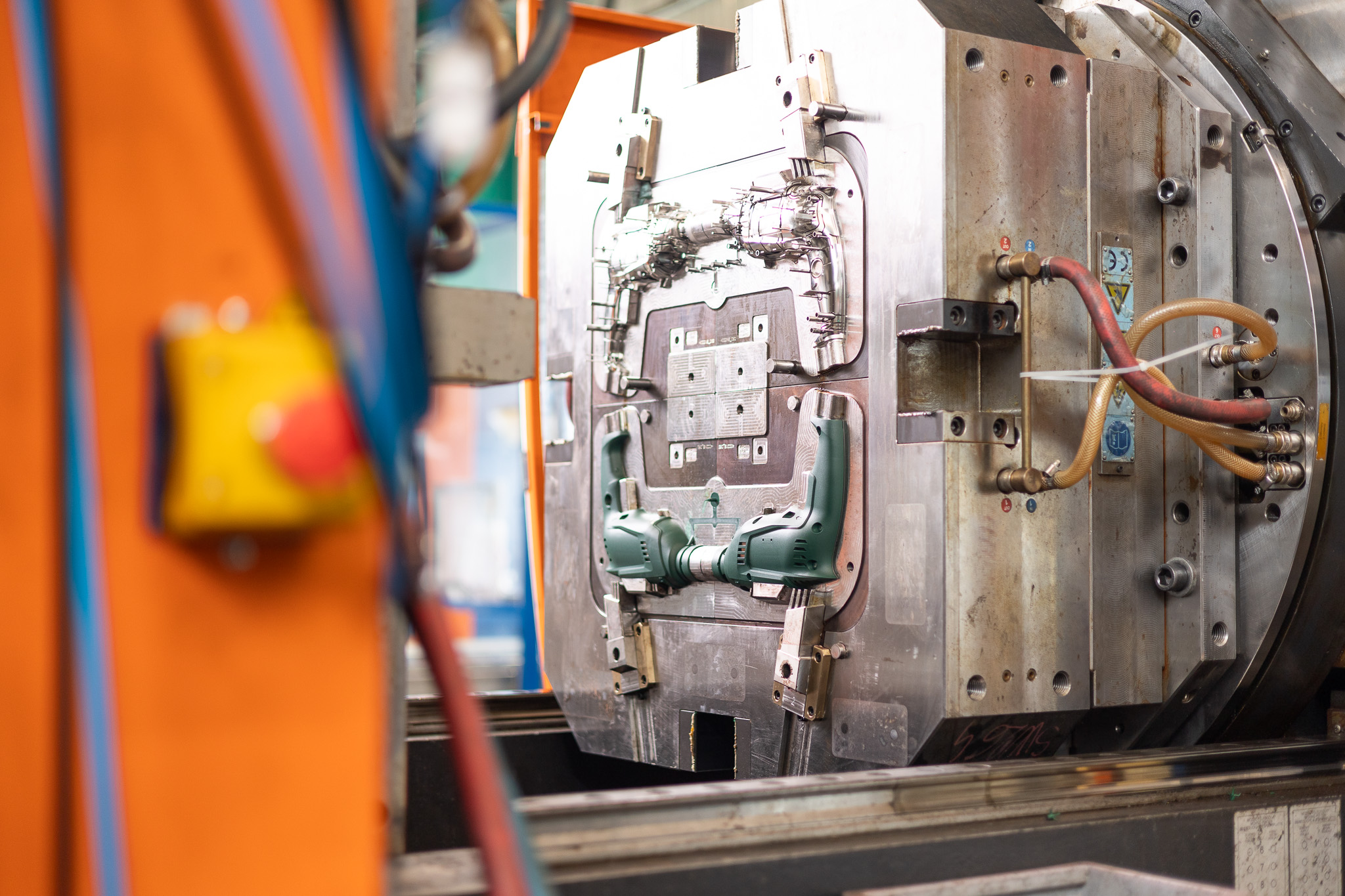
Injection moulding


The result: a successful tool-to-tool series production
A closed-loop system for power tools on an industrial scale is not only conceivable, but feasible. The classic UniversalImpact 800 drill is now an ambassador for closed-loop systems and makes a strong statement about the circular economy in general.


“I can’t think of any other project or product where the circular economy has been implemented so consistently in a field that has never before been considered in this context. The fact that we’ve ended up with a product that works very well naturally makes me feel proud.”
The launch of the special edition provided valuable metrics and answered questions such as: How long does it take to collect the necessary quantities? What percentage of usable material is realistic? What impact do additional process steps (such as the use of masterbatch) have on timing and planning?
As projects involving virgin materials typically do not face these issues and run on schedule, the use of recycled materials is often perceived as a risk. The insights gained from the project provide a fact-based foundation for addressing existing uncertainties and making future timelines and project cost estimates significantly more reliable — even though series production is still to come.
Impact: A higher proportion of recycled material
The certificate provided by the German testing company TÜV certificate states that 78 percent of the tool’s plastic parts on all externally visible components of the main product, excluding cables and accessories are recycled. 100 percent of the green plastic parts and 99 percent of the black plastic parts are made from closed-loop recyclate. The latter is supplemented by the colouring masterbatch (1 percent). The remaining parts are made from different types of plastic or are coloured differently and account for 22 percent of the drill. These components include items such as switches, drill chucks and soft grips.
In addition to certifying the proportion of recycled material, the TÜV audit confirmed that HolyPoly employs an exclusively mechanical recycling process and does not use any chemical additives.

From one-off to industry standard
With this project, Bosch Power Tools has initiated a transformative process that demonstrates the potential of circular material use for high-end technical products. It is a clear demonstration of the feasibility of a genuine closed-loop system for power tools and has already provided valuable insights into Bosch’s qualification processes and the structure of complex supply chains.
To make the tool-to-tool loop economically viable on a large scale, HolyPoly and MKV plan to actively drive development forward and test industrial approaches to material processing. The aim is to further develop and scale the automated sorting processes to extract unwanted materials even more efficiently down to the flake level, i.e. the level of individual shredded plastic pieces.

From left to right: Felix Schulz, Victor Jibrin, Thomas Hampel, Pascal Haaf, Anne Purper, Kai Zies, Heiner Lukas, Fridolin Pflüger

Laura Cordes
will be happy to answer any questions you may have about the project.